

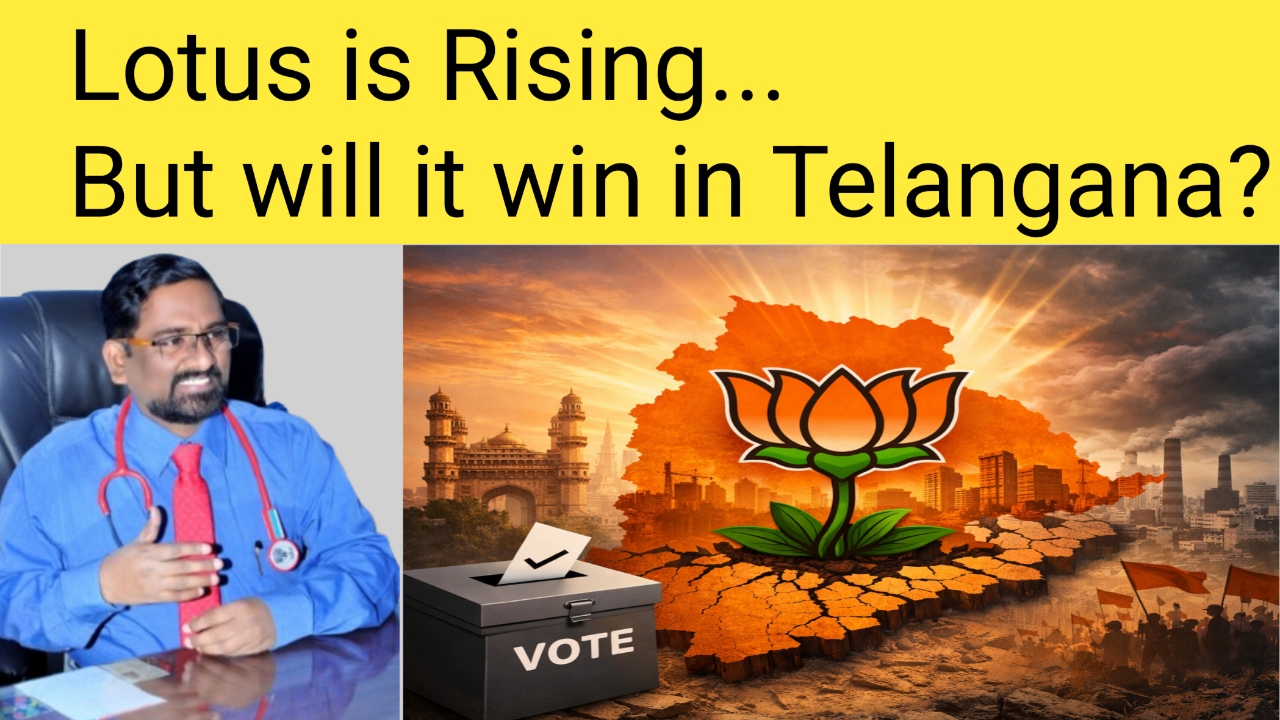
Dr. Keshavulu Bhashavathini, M.D. (Psychiatry),
Chairman: Telangana Intellectuals Association, 85010 61659, drkeshavulu@gmail.com
The results of the Telangana Municipal Elections held on February 11, 2026, have turned out to be something of a “reality check” for the Bharatiya Janata Party (BJP). After a strong performance in the 2024 Lok Sabha elections—winning 8 MP seats with a 35% vote share—the party appeared to be on an upward trajectory. However, these local body elections delivered a sharp reminder: increasing vote share is one thing; converting those votes into power on the ground is another.
The results once again underline a fundamental political truth—rising vote percentages do not automatically translate into electoral dominance. BJP’s growth in Telangana has not been a smooth, uninterrupted journey. While its vote share has steadily increased, the elusive “magic figure” required for forming a government remains out of reach. A deeper statistical and sociological analysis is essential to understand why.
Vote Share vs. Seat Conversion
In politics, gaining votes and converting them into seats are two entirely different battles. Geography plays a decisive role. BJP’s votes are largely concentrated in North Telangana—Adilabad, Karimnagar, Nizamabad—and parts of Hyderabad and its surrounding areas.
However, in the combined districts of Nalgonda and Khammam, there are dozens of constituencies where BJP still struggles to cross even 10% of the vote. While the statewide average of 35% vote share may appear impressive, without significant growth in South Telangana, securing the majority mark of 60 Assembly seats remains mathematically impossible.
Telangana currently witnesses a triangular contest—Congress, BRS, and BJP. BJP draws support largely from Hindutva mobilization and Prime Minister Narendra Modi’s image. Yet anti-incumbency votes are often split between Congress and BJP, ultimately benefiting either the ruling party or the strongest opposition force—currently Congress.
Consider the trajectory:
2018 Assembly Elections: 7% vote share, 1 MLA
2023 Assembly Elections: 14% vote share, 8 MLAs
2024 Lok Sabha Elections: 35% vote share, 8 MPs
The vote share is clearly rising. Yet the Assembly seat count remains stuck below double digits. This means BJP is increasing its vote base—but not pushing it across the winning threshold in enough constituencies.
Social Equations
Telangana’s politics is deeply influenced by caste dynamics and identity-based mobilization. Though BJP raised the slogan of appointing a “BC Chief Minister,” influential BC sub-castes—except perhaps sections of the Munnuru Kapu community—such as Yadavs, Padmashalis, and Gouds have not fully shifted towards the party.
In SC and ST reserved constituencies, BJP’s performance remains weak. Congress welfare schemes and campaigns warning that the Constitution is under threat have created apprehension among these communities.
Muslims, who constitute around 13–14% of the population, have been voting strategically against BJP—leaning toward Congress or BRS. This directly impacts BJP’s prospects in nearly 30–40 constituencies.
Settlers from Andhra Pradesh residing in Hyderabad and surrounding areas supported BJP in the 2024 Lok Sabha elections. However, in Assembly contests, they prioritize local security and development, often preferring BRS or Congress. When emotional narratives outweigh development concerns, neutral voters tend to distance themselves.
Absence of a Strong Local Face
While Narendra Modi commands immense popularity nationally, Telangana lacks a unifying state-level BJP leader with similar appeal. Overreliance on nationalism is insufficient in a state where regional identity is deeply cherished.
Congress successfully projected Revanth Reddy as a fighter against KCR. Earlier, BJP generated momentum under Bandi Sanjay’s leadership, but his abrupt removal weakened organizational confidence and public trust.
Though leaders like Bandi Sanjay, Etala Rajender, and Kishan Reddy are present, internal divisions and factionalism prevent voters from seeing a clear Chief Ministerial face. The absence of cohesive leadership dilutes credibility.
Strategic Gaps
Lok Sabha elections revolve around national leadership and larger narratives. Municipal elections, however, are about drainage, roads, and drinking water. BJP’s campaign still revolves heavily around nationalism and central schemes, but it has not effectively built trust at the street level.
Congress and BRS have decades-old grassroots networks in villages and wards. BJP often lacks ward-level leadership and relies heavily on recent entrants from other parties. Ticket distribution disputes led to rebel candidates in several places, directly hurting its prospects.
After its Assembly defeat, BRS was expected to weaken. Instead, it made a comeback in municipal elections. Urban anti-incumbency votes split between BJP and BRS, ultimately benefiting Congress.
Middle-class voters and settlers in cities like Hyderabad, Warangal, Nizamabad, and Khammam—once BJP’s backbone—leaned toward stability this time. Since Congress governs the state, many believed municipalities aligned with the ruling party would receive better funding.
Lessons to Learn
The latest results serve as a warning for BJP. In Telangana, “Hindutva” or the “Modi image” alone cannot secure power. The image of leadership from above may increase vote share, but it cannot automatically raise the winning tally at the grassroots.
Without a strong organizational foundation, power will remain elusive. These elections show that urban voters now prioritize daily civic issues over emotional narratives.
If BJP shifts focus toward:
Development-oriented campaigns
Monitoring government fund utilization
Special attention to South Telangana
Strengthening ward-level committees
Building booth-level cadre
Forming alliances with ideologically aligned smaller groups
—then power in Telangana is not impossible.
But without structural correction, rising vote share alone will not guarantee victory.